Showing posts with label Maisha Soul. Show all posts

Saturday, May 3, 2014

What is Succeeding Together?

 photo SucceedingTogether5_zps7306f4ed.jpg

There is a community-based movement taking place in Democratic Republic of the Congo, supported by a program called Succeeding Together. It is structured to help women help each other by providing education, training, and leadership skills for creating businesses, assisting with family health, and economic development. Now that the graduates are enjoying success, they need a little of your help to spread the word about their work. They want to tell the people of Congo about the positive changes they've made in their lives and communities -- and want everyone in Congo to know that they can do it too.

Lasting, positive change in Congo has to come from the people of Congo. And it will.

Please help spread the word via social media, your friends, and your family.

KuangSi2Succeeding Together is a program that helps women improve their lives by learning leadership skills and then paying it forward. It is run by an organization called HOLD-DRC. HOLD is an acronym for Humanitarian Organization for Lasting Development, and was incorporated as a non-profit inside Democratic Republic of the Congo in April 2012. Succeeding Together is focused on helping single mothers -- teenage, unwed, abandoned -- build a better life for themselves and their communities.

Mothers of children born outside of marriage are often left to the periphery of society. Traditionally, they can hold no position of real respect, and often live with their children in abject poverty with no hope for a better life. There isn't even a common word for "unwed mother" in the DRC -- the term means "girl mother" at best, and it demonstrates that these women are not held in any esteem.

HOLD thinks these women have tremendous value. In fact, they have so much value that they can change the face of Congo.

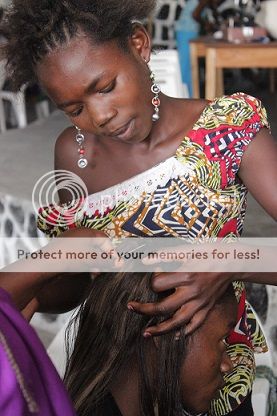
When a woman enters Succeeding Together, she joins a human development club of about ten other women who are living in her neighborhood. They support each other and share circular credit to help start and grow their businesses. Together, they become leaders in their community. They complete a comprehensive training program that includes:
KuangSi2
  • Earning an associate's degree in tailoring, cosmetology, or culinary arts.
  • Training in how to run a business.
  • Leadership skills, with focus on governance and peer education in human rights and basic health. This includes malaria prevention, HIV prevention, planned approaches to reproduction, and how to avoid and care for common illnesses such as respiratory infections.
  • Training in early childhood development. HOLD-DRC also runs a daycare for mothers who are studying in their programs. Day care centers are mostly unknown in the DRC.
  • Peer support and opportunities to exercise leadership.
  • Peer support in growing their businesses and establishing a credit history.

KuangSi2Most of the people in the DRC who want to start a small business don't have access to microcredit. That involves a bank, and they mostly haven't been in a position to attract one. To that end, HOLD has initiated a rotating credit program. The graduates of Succeeding Together can have access to a small pot of money which they share with a small group of other graduates in their neighborhood. If a group of five women shared a pot of $100, three women might borrow $20 each to grow their businesses and pay back the pot plus interest in six months. Then another woman has a turn to pay it forward. This keeps their businesses growing, and they establish a business ownership and credit history -- which is what a bank or credit institution wants to see before extending microcredit.

These women are sharing what they learned with other women, and together they are making quite an impact. Their lives are changed, their communities are stronger, and they are building a better future for Congo.

They want to tell others how. They want to grow their movement across the country.

There isn't a lot of communication in the DRC aside from national radio, so they need help to spread the word about how this program can help women help each other. Cell phone technology is growing by leaps and bounds, though, and internet access is becoming more common. These technologies are leading the way, so they have a new way to tell Congo about Succeeding Together:

They want to make their music video viral.

Maisha Soul, and Innoss'B are A-list Congolese pop musicians who offered their time, studio, and talents to make and distribute a music video with Succeeding Together graduates to spread a message of hope and change. This was shot in Goma, at HOLD-DRC, where their programs are held. The women are Succeeding Together are singing in their own words:


1st Verse:
My dream was to have a better life Everywhere I went, I couldn't make it happen Now, today I saw the way Who knew! that by my own strength I can do it Oh oh oh I saw the way! Stand up never give up -- it's never too late! 
Let's hold hands and succeed/overcome together.

2nd Verse:
Yesterday I had problems Here in the village I was laughed at My whole family threw me/kicked me out ah ah! My hunger/desire for life was exhausted But today I saw light I learned work/handicrafts I have faith now that I will overcome Oh oh i have faith now that I will . . . succeed Oh oh I have faith now that we will . . . . succeed

3rd Verse:
My name is [redacted]. I dream of being a counselor for construction, for unity. I would never dream of being a counselor of division, of hatred or of tribalism . . . .

4th Verse:
My dream is to contribute to the development of my country. My dream is to take care of myself my whole life long. Oh me, as I am a woman, I must be a complement, not a burden

Refrain:
Stand up never give up -- it’s never too late! Tushikane mkono Tushinde pamoja! (We will hold hands and succeed together!)

And if you want to help these women share their movement, please spread the word -- and the video. The more legs it grows the more it will accomplish! If you want to donate to this program, you can do so at ACT for Congo's nascent website.

Friday, May 2, 2014

Women in Congo Succeeding Together

Some of you here know me and are familiar with my interest in development and gender equality in Democratic Republic of the Congo. You have extended kind comments and interest in diaries I've written about HEAL Africa in the past, and expressed interest in new projects I stumble across. Well, today I want to tell you about something new and wonderful. I also have an action item for you at the end. First, I want you to meet Judy Anderson. Here, she is being interviewed at Clinton Global Initiative while she was director at the US based HEAL Africa, which she and her husband Dick founded: Judy is a talented facilitator. She has been working with national leaders, vulnerable people, and communities to find real solutions so people in Congo can build a better life. She grew up in Congo, and has been focused on helping groups address health, leadership, gender equality, economic growth, and conflict resolution for most of her adult life. Her focus and commitment recently lead her and Dick to found a new non-profit organization called ACT for Congo.

ACT's website is under construction and the tax status is still pending, but Judy is hard at work supporting real change. I think this organization is a genuine treasure. Following lessons learned by Robert Chambers (see Rural Development: Putting the Last First or Whose Reality Counts: Putting the First Last) and Paulo Freire, her goal is to find a way to support effective development projects in Congo that are run by proven Congolese community leaders and grassroots organizers. She partners with credible organizations who are doing effective work and demonstrating measurable, positive change in DRC communities.

International relief organizations have their role in helping countries ravaged by famine, upheaval, and war, but they execute temporary projects with finite goals. External relief does not often create any lasting positive change. Lasting change in Congo has to come from the people of Congo.

Next, I want to tell you about one of ACT's partner organizations, HOLD-DRC. HOLD is an acronym for Humanitarian Organization for Lasting Development. It was incorporated as a non-profit inside Democratic Republic of the Congo in April 2012. Its board of directors is made up of mostly people who worked as senior staff at HEAL Africa in Congo that were interested in approaching human development in an integrated way, and wanted to create a new organization focused primarily on improving Congo’s low human development index by addressing community development and public health.

HOLD runs an amazing program called Succeeding Together that is focused on helping single -- teenage, unwed, abandoned -- mothers. Mothers of children born outside of marriage are left to the periphery of society. Traditionally, they can hold no position of real respect, and often live with their children in abject poverty with no hope for a better life. There isn't even a common word for "unwed mother" in the DRC -- the term means "girl mother" at best, and it demonstrates that these women are not held in any esteem. HOLD thinks these women have tremendous value. In fact, they have so much value that they can change the face of Congo.

HOLD has a comprehensive training program for them. When they graduate, they have what is equivalent to an associate's degree in tailoring, cosmetology, or culinary arts -- as well as training in how to run a business. They learn leadership skills, and focus on governance and peer education in human rights and basic health, such as malaria prevention, HIV prevention, planned approaches to reproduction, and how to avoid and care for common illnesses such as respiratory infections. HOLD also teaches early childhood development and runs a daycare for mothers who are studying in their programs -- although day care centers are mostly unknown in the DRC.

Most of the people in the DRC don't have access to microcredit. That involves a bank, and they mostly haven't been in a position to attract one. To that end, HOLD has initiated a rotating credit program where its graduates can have access to a small pot of money which they share with a small group of other graduates. The group has democratically elected leadership, and all loan terms are negotiated collectively by the group's membership. So, if a group of five women shared a pot of $100, three women might borrow $20 each to grow their businesses and pay back the pot plus interest in six months. Then it's another woman's turn. The system keeps their businesses growing, and establishes a solid business ownership and credit history for them -- which is what a bank or credit institution wants to see before extending microcredit.

When a woman enters this program, she joins a human development club of about ten women who are living in the same neighborhood. They support each other and share circular credit to help start and grow their businesses. Together, they become leaders in their community. These women are sharing what they learned with other women, and they are making quite an impact.

In the following video, you'll meet a brilliant woman named Modestine Etoy. She is the coordinator of Succeeding Together: And here a woman tells her story:

In the video above, Natalie says that she doesn't have trouble buying soap anymore. In Congo, this is a euphemism for, "my basic needs are met." If you have food for your children and a roof over your head, you can buy soap. To date, 238 women have completed the training program -- and on April 14, a class of 83 more will graduate.
Here is the action request: The women want to extend their leadership by spreading their message that real change is possible in Congo. Unfortunately there isn't a lot of communication in the DRC aside from national radio. Cell phone technology is growing by leaps and bounds, though, and the internet is becoming more and more common. The women at Succeeding Together want to make a music video with famous Congolese musicians Innoss'B and Maisha Soul. If this video gets made, the message will ring across Democratic Republic of the Congo. The musicians have volunteered their time and studio for writing, recording, and filming the video with the women at Succeeding Together. They only need money for gas to run a generator to provide electricity to their studio for the time they need to work. My dear friend Kyondra Kennard posted a Kickstarter, which will expire in a few days. If you could donate a pittance, that would be great. If you can't -- could you please spread the word?
Kyondra's Kickstarter link is here. (This fundraiser has ended.)
Here is a recent Innoss'B video (he's the youngest brother in Maisha Soul -- and a celebrated star in Congo): Crossposted from elsewhere -- original post date was March 8, 2014. Note that this fundraiser is complete. If you want to contribute to similar projects, see www.actforcongo.org.

Maisha Soul: "Our music is our gun."

Reposted from elsewhere -- original post date was May 10, 2011
Photobucket
In the west, we hear hopeless stories about the war in the Democratic Republic of Congo, and it's hard to imagine that anything positive could be happening there. But it isn't all war and violence. There is a peace movement and it's got traction. A leading voice in this movement for peace and reform comes from the artists.

Maisha in Swahili means "life". They are Prince, Eric, Achilles, and Innocent Balume -- four brothers who chose to water the seeds of peace and hope rather than those of conflict and despair. They came to the US with to raise awareness about the peace movement -- that there is another way for Congo, and their country is so much more than brutality and violence.

The Lake Kivu region has been plagued by conflict and natural disasters. The genocide in Rwanda brought refugees across the border and destabilized the country. Soon, a revolution replaced the government (then Zaire), but the new leadership was unable to stop events that lead to the Second Congolese War, which is also called The Coltan War, The Great War of Africa, and The African World War. In 2002, near the end of the Second War, the nearby volcano Nyiragongo erupted, destroying about half of the city of Goma.

Maisha Soul was born after the eruption in a refugee camp. The war was over, but their lives hadn't changed -- they were living as if the war continued. Life was painful, and there was despair everywhere. It was then that the four brothers started to sing. They sang to lighten the hearts. The oldest brother and front man, Prince, told their story. They were dispaced by the volcano, but couldn't sit by and give in to the darkness. They knew that love was the answer. Loving brothers and sisters, yes, but also the identifable other. With pain and death everywhere, the only answer is love.
People were forced away from their homes, and often couldn't find shoes or food. Life for them was difficult. We sang to bring the message of love. If you live tomorrow it will be a miracle, but today you can choose love instead of despair.
(My paraphrase of Prince, who said it more beautifully.) Today, Maisha Soul works with other artists from Goma to spread a message of hope -- bringing the larger community together to find a better way. A way to love the other. Below, Maisha Soul performs with Emma Katya Katondolo, another artist/activist from Goma.

Because of the war in the Lake Kivu region, it is difficult for artists to have a voice. To this end, Maisha Soul is building a production company that will give legs to the music in Goma -- to provide recording technology and resources to help artists promote their work across the country and abroad. Congolese musicians are beginning to have a presence on the internet, so they will be able to connect with the world and spread their message of hope. Music is better than a gun. Update 5/2/2014: Here are some more recent videos by Maisha Soul. Innoss'B is Innocent, the youngest Maisha Soul brother: