Showing posts with label conflict metals. Show all posts

Saturday, May 3, 2014

What is Succeeding Together?

 photo SucceedingTogether5_zps7306f4ed.jpg

There is a community-based movement taking place in Democratic Republic of the Congo, supported by a program called Succeeding Together. It is structured to help women help each other by providing education, training, and leadership skills for creating businesses, assisting with family health, and economic development. Now that the graduates are enjoying success, they need a little of your help to spread the word about their work. They want to tell the people of Congo about the positive changes they've made in their lives and communities -- and want everyone in Congo to know that they can do it too.

Lasting, positive change in Congo has to come from the people of Congo. And it will.

Please help spread the word via social media, your friends, and your family.

KuangSi2Succeeding Together is a program that helps women improve their lives by learning leadership skills and then paying it forward. It is run by an organization called HOLD-DRC. HOLD is an acronym for Humanitarian Organization for Lasting Development, and was incorporated as a non-profit inside Democratic Republic of the Congo in April 2012. Succeeding Together is focused on helping single mothers -- teenage, unwed, abandoned -- build a better life for themselves and their communities.

Mothers of children born outside of marriage are often left to the periphery of society. Traditionally, they can hold no position of real respect, and often live with their children in abject poverty with no hope for a better life. There isn't even a common word for "unwed mother" in the DRC -- the term means "girl mother" at best, and it demonstrates that these women are not held in any esteem.

HOLD thinks these women have tremendous value. In fact, they have so much value that they can change the face of Congo.

When a woman enters Succeeding Together, she joins a human development club of about ten other women who are living in her neighborhood. They support each other and share circular credit to help start and grow their businesses. Together, they become leaders in their community. They complete a comprehensive training program that includes:
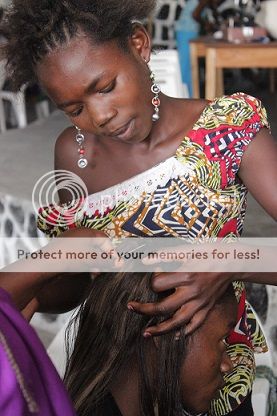
KuangSi2
  • Earning an associate's degree in tailoring, cosmetology, or culinary arts.
  • Training in how to run a business.
  • Leadership skills, with focus on governance and peer education in human rights and basic health. This includes malaria prevention, HIV prevention, planned approaches to reproduction, and how to avoid and care for common illnesses such as respiratory infections.
  • Training in early childhood development. HOLD-DRC also runs a daycare for mothers who are studying in their programs. Day care centers are mostly unknown in the DRC.
  • Peer support and opportunities to exercise leadership.
  • Peer support in growing their businesses and establishing a credit history.

KuangSi2Most of the people in the DRC who want to start a small business don't have access to microcredit. That involves a bank, and they mostly haven't been in a position to attract one. To that end, HOLD has initiated a rotating credit program. The graduates of Succeeding Together can have access to a small pot of money which they share with a small group of other graduates in their neighborhood. If a group of five women shared a pot of $100, three women might borrow $20 each to grow their businesses and pay back the pot plus interest in six months. Then another woman has a turn to pay it forward. This keeps their businesses growing, and they establish a business ownership and credit history -- which is what a bank or credit institution wants to see before extending microcredit.

These women are sharing what they learned with other women, and together they are making quite an impact. Their lives are changed, their communities are stronger, and they are building a better future for Congo.

They want to tell others how. They want to grow their movement across the country.

There isn't a lot of communication in the DRC aside from national radio, so they need help to spread the word about how this program can help women help each other. Cell phone technology is growing by leaps and bounds, though, and internet access is becoming more common. These technologies are leading the way, so they have a new way to tell Congo about Succeeding Together:

They want to make their music video viral.

Maisha Soul, and Innoss'B are A-list Congolese pop musicians who offered their time, studio, and talents to make and distribute a music video with Succeeding Together graduates to spread a message of hope and change. This was shot in Goma, at HOLD-DRC, where their programs are held. The women are Succeeding Together are singing in their own words:


1st Verse:
My dream was to have a better life Everywhere I went, I couldn't make it happen Now, today I saw the way Who knew! that by my own strength I can do it Oh oh oh I saw the way! Stand up never give up -- it's never too late! 
Let's hold hands and succeed/overcome together.

2nd Verse:
Yesterday I had problems Here in the village I was laughed at My whole family threw me/kicked me out ah ah! My hunger/desire for life was exhausted But today I saw light I learned work/handicrafts I have faith now that I will overcome Oh oh i have faith now that I will . . . succeed Oh oh I have faith now that we will . . . . succeed

3rd Verse:
My name is [redacted]. I dream of being a counselor for construction, for unity. I would never dream of being a counselor of division, of hatred or of tribalism . . . .

4th Verse:
My dream is to contribute to the development of my country. My dream is to take care of myself my whole life long. Oh me, as I am a woman, I must be a complement, not a burden

Refrain:
Stand up never give up -- it’s never too late! Tushikane mkono Tushinde pamoja! (We will hold hands and succeed together!)

And if you want to help these women share their movement, please spread the word -- and the video. The more legs it grows the more it will accomplish! If you want to donate to this program, you can do so at ACT for Congo's nascent website.

Sunday, November 25, 2012

The best of grassroots in the Congo.

Posted elsewhere, September 2010.

Update: Mama Muliri now collaborates with HOLD-DRC, who is ACT for Congo's founding partner:

KuangSi2In December (2009), one of the HEAL Africa counselors was dispatched from Goma to Lubutu to advocate for a woman that needed legal help. The woman was a patient in a hospital where a nurse raped her. She was poor and powerless to prosecute him without HEAL Africa's help.

When the counselor intervened, the hospital administration fired the nurse, who was sorely indignant at losing his job. He had been well paid, so his family lost their standard of living. Tribal leaders in the local villages saw this as a grave injustice against the man, and began to make dire threats to kill the counselor, and they promised to band together and sabotage HEAL Africa's operations throughout the region.

This story has been unfolding since last December, when a huge transformation was born in North Kivu and Maniema. This is political change rooted from the ground up, organized by HEAL Africa in partnership with the American Bar Association. Their work is bearing fruit.

The ABA/HEAL Africa partnership teaches people about the DRC constitution passed in 2006. The new law defines rights for women and children; it defines “abuse”, and clarifies inheritance. Rape is now illegal in all contexts, and young girl cannot be married to an older man. They provide legal counsel for victims of sexual violence, and support them through the prosecution. ABA/HEAL Africa also works with local judges and lawyers to create a justice system where rapists go to jail and sentences stick.

KuangSi2This is Mama Muliri. She is a community organizer who founded HEAL Africa's Heal My People program. She brings the best of grassroots activism to the Democratic Republic of Congo.

Muliri responded to the threats by going to Lubutu herself and facing the tribal leaders eye to eye. As promised, they met her brandishing machetes and guns. They chanted and threw rocks at her, but she stood her ground, told them about the new constitution passed in 2006, and explained how the law differed from the tribal customs. She demanded that they comply with the law, and asked them to attend a HEAL Africa conference on conflict transformation.

A tribal chief holds the keys to changing society in his village. A chief's voice trumps the national law, which is often not trusted or understood, because it is written by unknown people in remote places. The chief determines the de facto law and chooses what is ethical and moral. He defines the values in his community. Tribal elders advise him, and they and act as judge and jury for all local disputes. The chief's word is final.

Mama Muliri's act of defiance marked the beginning of a rich collaboration between HEAL Africa and the tribal leaders. They are now working together to create a new future for the Congo.

HEAL Africa and the ABA conducted three days of meetings where the tribal leaders learned about the new DRC constitution and how traditional practices conflict with the law. The chiefs worked together to address the conflicts near their villages, and formed strategies to transform the regional conflict and protect their villages. The chiefs took to this cooperative organization like fish to water, and saw a new way that was better for their communities. The chiefs chose to enforce the new law en mass, and they had a demonstration and march through the city to proclaim it so.

The tribal leaders now regularly network with HEAL Africa and with each other to serve and protect their people. Muliri works closely with the tribal leaders throughout the North Kivu and northern Maniema regions, and continues to hold conflict transformation seminars about legal issues and strategy to resolve long term conflicts; right now, they are implementing an intensive program to keep their youth out of the militas.

A few days ago, HEAL Africa USA learned that a chief from the Lubutu area collected eight new victims of sexual violence, six women and two men, and immediately notified HEAL Africa so they could be treated and transported to the hospital in Goma. That is a far cry from threatening counselors with rocks and machetes. HEAL Africa has a network of "safe houses" in the areas surrounding the war that provide support for the local communities. They are first-responders to victims of war violence; they educate people about HIV/AIDS, and administer immediate prophylactic care to rape victims before they are transported to the hospital. HEAL Africa works with their Nehemiah Committees, cooperative groups made up of respected Catholic, Protestant, Muslim, Kimbunguist -- and now tribal -- leaders that are committed to changing the future of the DRC. Much grassroots work is done through these networks, and the "safe house" role is expanding with each collective success. HEAL Africa recently suffered from large funging cuts, and the grassroots programs were cut to skeleton crews on July 1 in order to keep the hospital open.

Monday, May 10, 2010

Your cellphone is killing people: Regulate conflict minerals in the DRC

In 1994, a Hutu paramilitary organization called the Interahamwe perpetrated a mass genocide in Rwanda against another ethnic group, the Tutsi. In response, the Rwandese Patriotic Front eventually drove the Interahamwe, their supporters, and the Hutu who feared retaliation from Rwanda into nearby countries: over two million people crossed the border into the Democratic Republic of Congo.

The Interahamwe remain in the Democratic Republic of Congo today. They now call themselves the Forces Democratiques de Liberation du Rwanda, or the FDLR. They compete with other groups to control the Coltan mines in the DRC, but they set the bloody standard for terrorism in the neighborhood.

The violence connected with these mines is absolutely monstrous. The militias use terrorism to intimidate the people, and the most brutal are the ones who gain control of the ore that comes from the mines. But the weapons of terror are not car bombs or explosive devices. They use public torture and rape to intimidate the Congolese people. Nicholas Kristof recently described the horrible conditions that result in his columns The World Capital of Killing, and From "Oprah" to Building Sisterhood in Congo.

More than two hundred thousand Congolese women and children have been raped and mutilated, often in front of their families or in front of the whole village -- and this has been going on for years. Among the stories that the UN reported in 2005, paramilitary men grilled villagers' bodies on a spit and boiled two girls alive in front of their mother. More often they gang rape a woman, penetrating her with weapons and mutilating her. Sometimes they use machetes or guns, and they are reported to set her on fire, as well. Those who survive are often left entirely incontinent because they suffer from traumatic gynecologic fistula -- destruction of the tissue between the vagina, bladder, and bowels. The UN reports tens of thousands of these rapes per year. There is an increasing number of men who suffer this fate, as well.

Jeanette and her husband were farmers when the Interahamwe stormed into their village and burned it to the ground. They raped and tortured her, cut off both of her hands, and left her for dead. They raped another woman in the village who was pregnant, penetrated her with a rifle, and shot her.

The Interahamwe killed Generose's husband, hacked off her leg with a machete, and cooked it in front of her family on their kitchen fire. When her 12-year-old son refused to eat it, they killed him.

The violence continues, and stories like these play out daily in eastern DRC. The causes for the conflict in the DRC are complicated, but one thing is simple: the suffering continues because of the mines. Militias directly control the region's coltan and tin production. At the end of 2007, the International Rescue Committee estimated that nearly 5.5 million people had died, and that number continues to rise.


I want to draw your attention to coltan, which is the ore that contains tantalum. From an engineering perspective, tantalum is a sweetheart metal. It has ideal mechanical, thermal, and chemical properties. It can be heated to very high temperatures, it is stable in corrosive environments, and it machines well. It also maintains these properties after heating; tungsten, for example, becomes extremely brittle and fragile once it's heated, which is why incandescent light bulb filaments break so easily. This is not so with tantalum, which can be re-machined after heating to high temperatures. Alloys of tantalum behave nicely, as well.

The video refers to widespread use of tantalum capacitors, but because of its favorable properties tantalum is commonly used in industry. Camera lenses are made with tantalum oxide. Tantalum metal is ideal for making surgical implants and instruments -- it even bonds with hard tissue better than other metals. Its ductility and suppleness make it the metal of choice for fine wires and long-lasting filaments, and its alloys are used in jet engines, missiles, and process equipment for engineering across the board. Our technology makes us dependent on this precious metal.

** Jeanette and Generose's stories are told by Women for Women International, another organization that is doing fine work to support war survivors in the DRC. Read about Jeanette in The Other Side of War by Zainab Salbi; Nicholas Kristof tells Generose's story in the links provided.

Monday, May 3, 2010

Silence in the Democratic Republic of Congo

KuangSi2
Update: Mama Muliri currently collaborates with HOLD-DRC. HOLD (Humanitarian Organization for Lasting Development) is a Congolese NGO. They are founding partners with US-based ACT for Congo.

Meet Jeanne Muliri Kabekatyo, known as "Mama Muliri" to her friends and colleagues. This brilliant woman pioneered the Heal My People program at HEAL Africa, a Congolese relief organization centered in Goma, Democratic Republic of Congo. She is visiting the United States and telling the story of how HEAL Africa is changing the face of the Democratic Republic of Congo. She is without a doubt one of the more inspiring people I know.

Mama Muliri directs HEAL Africa's program Gender and Justice, which is a strategic, long term response to gender-based violence. She is the ultimate community organizer, bringing together leaders from area villages, faith-based organizations, and relief workers, and the women of the DRC to affect positive change in a lasting way. They will create a new future.


HEAL Africa began as a small clinic, but it was destroyed when Mount Nyiragongo erupted in 2002. They've since rebuilt, and are now a teaching hospital with a state of the art surgical center, specializing in traumatic gynecologic fistulae.
These injuries commonly result from the brutal rapes that happen because of the war. Women are attacked and raped sometimes by groups of twenty or more men. These men penetrate them with weapons and sometimes shoot, burn, or mutilate and then leave them for dead. HEAL Africa's hospital was designed to treat their wounds.

But when the hospital opened, the doctors couldn't find many rape victims. Only women who were dying of infection or gravely injured would come. HEAL Africa had an empty treatment facility in the middle of what is arguably the worst systematic, gender-based violence on Earth today.

The Democratic Republic of Congo lives a culture of silence. By the old ways, a woman who is raped is shunned by her family and cast out of her community. She has no worth in the world, and is utterly destroyed by the crime. If it happens and she can keep it secret, she will suffer in silence. This is why HEAL Africa and Mama Muliri are so important. The women don't easily trust, because the risk to their future is so great. Why should a woman go to a hospital for treatment when it means that she must break her silence?

Mama Muliri knew that the hospital would not be a safe place for the women who needed treatment unless the culture of silence was broken. To accomplish this change, she had to engage the men -- so she and her colleagues went to the religious leaders and convinced them to teach their people about the culture of silence and why it was wrong.

Then she and her colleagues went to the leaders in the villages and taught them how their ways conflicted with the law, and convinced them that their traditions regarding rape had to change. This tactic was hugely successful, and the villages began to comply with the law. The villages started to support the rape victims, and HEAL Africa trained village women in crisis counseling to help rape victims get the care they need. From this work came the Nehemiah Committees made up of Catholic, Protestant, Muslim and indigenous church and village leaders:


These initiatives took the name of “Nehemiah Committees”. In 2004, the first three committees were established, today there are more than 65 throughout rural villages in the surrounding region of Goma.
...
The name for the program derives from the Old Testament book of Nehemiah, where a community is mobilized to rebuild the walls of their destroyed city. Nehemiah Committees are locally selected by community members and represent all faiths and tribes in the community. The various faith communities...are at the heart of the work and the focus of the training.


The women in these villages now have a safe place to break their silence.

But what would become of the women after their treatment? If they went back to their villages as victims, the culture of silence would persist. Mama Muliri thought that calling them survivors wouldn't work, either, as it did nothing to remove the stigma of being raped, and it was not a lot different than saying the women were victims. She and HEAL Africa started a vocational training program to give the women skills that their village depended on -- and she called the graduates Strong Women in the Community.

It didn't make sense, though, to allow only rape victims to be the Strong Women. First, a women who had not suffered a rape needed vocational training, too -- and second, creating Strong Women in a way that was independent of their trauma history helped to remove the stigma attached to the rape. Their rape wouldn't define them in their community. HEAL Africa opened their training program to all women, and gave birth to their Women Stand Up Together program.

Women Stand Up Together has a network of safe houses where women receive support in crisis, training, and resources they need. The village counselors can go to the safe houses to learn new skills, and the women can network to build a sustainable future for the DRC.

The safe houses also provide a way to administer or acquire urgent and preventive care for rape victims:

Village counselors also know to refer to local medical clinics for infections, sexually transmitted diseases, or Post Exposure Prophyllaxis (PEP for HIV will dramatically reduce transmission of HIV if administered within 72 hours of a rape. Most villagers don’t know this, and it’s not available in many clinics out of the city.) HEAL Africa has been working with 67 rural clinics to provide training and medicine, and through the counselor networks to inform women and girls of the urgency of getting treatment quickly.


Women Stand Up Together started with 4 safe houses; they now have 28, and they are making an enormous impact on the quality of life and status for women they serve. HEAL Africa also has a fledgling microcredit program that is about six months old. They've already paid back their principle and interest, and are using the profit that microcredit brings to provide more loans to women who want to start businesses.

And this is what sets HEAL Africa apart from other relief organizations working in the DRC. HEAL Africa is founded and led by Congolese people, so it can build itself and grow through community organization. Foreign relief agencies are helping tremendously in the DRC, but they are centrally located and cannot reach the villages with community networks like HEAL Africa. And they cannot build a lasting peace -- only the people of the DRC can create a peaceful future for their country.

KuangSi2This is Marta, and she wants us to hear her story. She was badly injured when she was raped and burned, and she made her way to the HEAL Africa hospital through the community networks described here. She was a resident at HEAL Africa's Grounds For Hope shelter that houses women who need time to heal because of their extensive injuries. To date, she has had five reconstructive surgeries to help her close her eye lids and regain balanced use of her arms.

She told her story to Ben Affleck in 2008 when he traveled to the DRC for ABC's Nightline -- her interview starts about 2:50 in this excerpt:


Update: Since this writing, HEAL Africa has discontinued its Women Stand Up Together programs and Nehemiah Committees.